Community art therapy and racial justice
Changemakers
InSight – Spring 2026
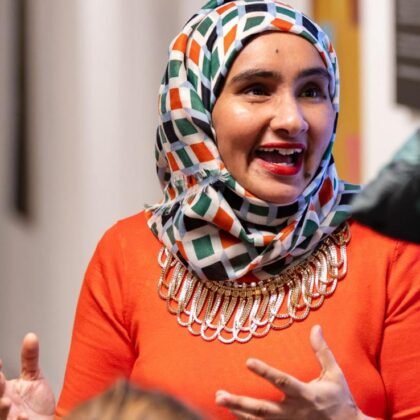
In our new changemakers series, we talk to art therapists who are driving change in the profession. Thahmina Begum is an art therapist and artist with over two decades of experience in community practice across Yorkshire and beyond. Thahmina shares what matters to them, what they’re doing about it, and what they hope for the future.
Join Thahmina at our annual conference: 7 November 2026
Transcript
I’m really passionate about community art therapy projects and delivering in the community for the community. I came in to art therapy, with a background of, youth and community. So I’ve worked over 20 years in the community at the intersection of arts and health.
When I was a kid, I loved art, it was my favourite subject. And I got a place at art college, but my dad wouldn’t allow me to go to art college. He would say stuff like, “Oh, you’re not gonna make any money out of it. What is this profession?” It wasn’t just the norm.
So I did end up going to college, and I did my A-levels in nursery nursing and actually that gave me a really good foundation of child development. And then I did my undergrad in youth and community development, because at the time I was working for a really long time firstly in education charity, and then in health charity for many, many years working with grassroots community groups. And I founded a number of them.
And it was through that work that I started to incorporate, arts into the weekly group sessions.
So we were commissioned through NHS and we did, what was prescribed for us. So we did the, you know, five-a-day and we did like cooking classes and we did walking groups and things like that. And I watched and I observed the participants over the years and nothing really was much happening.
And then I was also working as a practicing artist as well at the same time. So I went back to college as an artist, went back to art school as well, and I slowly filtered art activities into the groups I was working with. And I just saw the transformational nature of what was happening within them groups. And I saw that the women and young people started to talk about things and reflect on things and bring about memories. And then slowly we they started talking about issues that were important to them locally, and then also things that were important to them globally and making them connections as well.
So then that’s what really struck me. And I thought: “There’s something so powerful and something really equalising. When you’re doing art making together.” I thought to myself – there’s all these years that I’ve worked in health inequalities, I’ve worked as a practicing artist, and I thought, I’m going to become an art therapist.
But also simultaneously, there’s lots of things happening. At that time, I was seeing the disproportionate nature of particularly ethnic minorities going into acute mental health settings, working in community development and working really hard to get referrals or signposting into mental health services for the group members and them not accessing them services. A: because it was inaccessible in terms of the venue or them coming back and saying to me, Thahmina that they just don’t really understand me and I thought I will really want to make a difference and all that sort of lived and living experience that I’ve got, I would really like to put into this profession.
What issues do you want to raise awareness of?
Cultural issues that I would really love to raise awareness of is that cultural competence. Mental health services really need to understand the complexities and nuances, particularly around racial and intergenerational trauma.
And I think, the mainstream mental health models, very much rooted in Eurocentric frameworks that often, fail to understand, or include communities affected.
And, over the years, I’ve, I’ve been privileged enough to work both as an artist and as an art therapist, and often the issues of colonialism, migration, systemic racism and generational silencing in particular, shapes emotional and psychological experience of racially minoritised communities. And it’s bringing about awareness of – it’s not just them individual factors of health and health inequalities. It’s things that affect communities as a whole.
So really thinking not just in the micro element, but also the macro and chrono elements of factors of when you’re working with individuals and communities as well.
Access to mental health is really, really patchy. And I think there’s gaps in access and particularly mental health services are either inaccessible and particularly the communities that I work with, they’ve often said they felt alienated. So then this in some ways sort of exacerbates the historical mistrust and stigma.
And like I said, the reason I wanted to train was seeing the lack of diversity in that sector, so that underrepresentation of ethnic minority communities and services that don’t reflect or include community voices, particularly in design and delivery. So there’s not really that authentic co-creation when you’re delivering, mental health services, particularly when there’s a real strong emphasis on health inequalities and it’s them communities that need it the most, which are being silenced are voiced out of them services.
What projects are you most proud of?
I feel really passionately about how art therapy can be embedded in so many different spaces and so many different sectors, and we can work really interdisciplinarilly, with the knowledge and the skills that we’ve got. And we bring an abundance!
There’s an amazing arts organisation called Yorkshire Contemporary, Leeds, where we explored whether art could be a form of healing with racial trauma. I designed, these sessions using a Creative Laboratories method. So it was really carefully curated, and I worked together with the curators to really sensitively think about.
So we have we have three sessions with multiple generations. So we had older people, adults, and then we had young people, and we did some body mapping where we explored how it would feel in the body. And then that’s when we started to having some collected voices saying, oh, that happened to me. Then someone else said, oh, that happened to me. And then there was communication between them.
So it was, that space where you could allow and hold that space really carefully for people to find solidarity between each other, listen to each other’s stories and sort of empower themselves and then slowly just give that psychosocial education of, well, this is what was happening to your body.
Another really amazing project that I did, was within a research project I worked with an architect from the University of Leeds, Dr May, and we were exploring women and girls safety and their perceptions of safety in public spaces.
So she was looking at the physical aspect of safe spaces, and she brought me in to explore the psychological and emotional safe spaces for women. I created a series of workshops and then we, and then we explored that, and then we had an exhibition together. So it was again, it was about that psychosocial element of that workshop.
I was a co-investigator on that project, but also using all art therapy methodologies. And part of that success of that was getting underrepresented, women into research and having all voices. Because if we’re going to change stuff. often you don’t get a chance to.
And then, another project, which I’m really, really proud of was working with was a community art therapy project, working with the British Library, where we worked with unaccompanied asylum seekers.
So with Leeds Social Care, which looked after the young people, then the British Library, we use their maps archives, to explore the theme of maps and journeys. So we explored their journey from their home country to the UK and the traumatic experiences that they had through artmaking. And with that, it was really carefully created because many of them just missed out on their childhood. So it was really being experienced and thinking about, ‘Well, what’s missing?’
So we used things like sand and playdough and all that element of childhood experiences that they missed out on. And it was so lovely to see them, doing handprints and footprints and that element of, you know, just laughing and joy, but also that element of revisiting them memories in a really, really safe way, but then also understanding that they were creating something really lovely and beautiful that was going to be part of an exhibition that really gave that dopamine hit, that they’ve created something.
What impact have you seen?
So with the British Library project, because I said I’m an art therapist. I said, “I will require supervision.” So, we did group supervision, with the social workers as well as the apprentice.
So it was really lovely how you can start embedding new ecosystems and get organisations to think differently of the requirements.
And then because I did that project with them, they’ve got another project and they’ve asked me to come along to do reflective practice with their artists. So really trying to open up different conversations, not only as an art therapist, but also as an artist. And think about the ethics of care of all your team and the skills that you could, not only do for delivery, but also in systems change and different ecosystems that you’re working with.
And I think because of the collaboration and the relationships that you form with the partnerships, you’ve got a real ability to change the next project and change the next project.
So not only I’ve seen with the participants, particularly where there’s been community projects, you’ve really seen the confidence with individuals and participants since then try another project or go on to signpost or refer somewhere else, but also the teams that you’ve worked with. I’ve really see that collaborative change that they can start thinking differently and becoming more, creative and being more curious to ask questions.
What keeps you motivated?
When institutions actually listen and hear and then act upon, what you’ve said rather than taking things tokenistic and not really changing anything. And I’ve been really lucky that, lots of institutions have really cared and really wanted to make changes.
I remember I was working with Leeds Art Gallery it was just before Covid or just after Covid, and they were doing a decolonisation really big exhibition. And they asked myself and a few of the artists to be part of their advisory group.
I talked to about many of the institutions, particularly when you’re working with sensitive topics, often leave a certain feeling for that participant, particularly from the global majority.
And I said, I feel it’s the responsibility of the gallery or the museum to hold them spaces.
And I gave them a suggestion of having a conversation table just a part of that exhibition.
And I was really surprised because they actually did. And then I worked on it as an art therapist. So it was really amazing. So we had we had the exhibition and the table was placed right bang in the middle of that exhibition, and there was all sorts of people asking questions and being curious.
So we had cards where people could, write their opinions or draw their opinions about the pieces that were on the walls. And then these were added on to the interpretations.
And what was fascinating was that people were finding the public’s interpretations more fascinating than the curators interpretations.
What’s your advice to fellow art therapists?
My advice would be to start small, but stay really rooted. And think about why do you want to work on that issue in the first place and why it matters to you? And I think, think about why is it that I want to do this project, is it a personal issue, is it a lived on living experience – so that heuristic approach of ‘Well I’m still living with this issue, I really want to highlight it.’ Or is it something that’s drawing you from a community perspective? Really take a little bit of time to think and reflect on that. And keeping that level of authenticity, I think, is really, helpful, if it’s a project that you really want to highlight.
And then speak to people that are in that space, and, you know, this could be like a community group or it could be a grassroots organisation across the arts and health spectrum – or a university or school. It could be right across the board.
And then speak to your fellow practitioners that are in that space already. And then I would listen and learn and offer your skills in that service, but not saviorship because often I’ve seen, people come in to tell people what to do rather than listen and learn.
And I think you don’t need a perfect plan. I think you just need to be curious and ask questions and and build up rapport, build up relationships, and be led by the community.
Because it’s not just about your ideas. It’s about things evolving and changing once you’ve listened to people’s ideas.
What potential do you see for art therapy?
I am so proud to be an art therapist, and I think art therapy got so much potential.
And I think it’s like I said, I think it holds incredible potential to disrupt, traditional hierarchies, like I said, particularly in mental health, as it, you know, around accessibility that embodied nature that we have in art therapy and that cultural resonance that we have in terms of healing.
And I think where the strength is, is that we’ve got that ability to hold the complexity of conversation and give spaces for stories that have either been silenced or not been told.
And one of the reasons why I trained as an art psychotherapist, having worked in communities for a really long time, and not just a traditional talking therapist, was because I saw the power of that non-verbal.
And that ability for you to be able to tap into your unconscious and particularly when you’re working with racial and intergenerational trauma and the communities that you’re working with often, you know, either they’re not being brought up to speak or not give eye contact.
And that triangular relationship that we have and that projection onto that image making makes it so powerful and therefore accessible to the many, not just the elite few that are privileged enough to access therapy.
And hence, that’s the reason why I’m really passionate about community art therapy, because I see, when you place it into community or doing the preventative work, rather than waiting for something to get to acute level, there is that – absolutely and rightly so – that element to get into acute services.
But actually, if we invested the funding into community art therapy, that’s where a lot of preventable, social, educational, global issues, we could really, really make big waves in.
What changes would you like to see in the profession?
In order for the profession to evolve, I think there’s four key areas.
I think that’s around decolonising the training. So incorporating like critical race theory explorations and discussions around power and privilege and also that exploration around non-Western healing methods in mental health. So you know, really broadening that conversation of what could happen in that training element.
And then I think as I’ve touched on, I think we really, really need to think about diversifying the workforce because, you know, like I said, thinking about that macro and chrono elements of systemic and institutional, oppression, barriers and factors. If you are a white woman and that’s your therapist, you could be that systemic barriers for that individual particular from the global majority without even opening your mouth. You could represent that. So, and you could be the nicest therapist, but if that’s what you represent to that individual, the battle is even more harder.
We really need to think about, access. So really, really thinking about who has access, why they have access and who has sort of the worst are the poorest health outcomes. So where we need to we really need targeted support, targeted funding. And therefore then that goes back to communities that really, really need them. So it’s full circle.
And I think we really need to start thinking about, shifting the power in art therapy. So where we really need to include people with lived experience and living experience. So things like racial trauma don’t go away. Things are people like displaced and migrants. Their issues don’t go away. So there’s that heuristic approach of when you’re co-designing or co-creating, services and including them from the start. So design and delivery and also recognising community voices, and community knowledge is just as valid, and valuable when you’re designing frameworks and services and commissioning.
These are all things that we can do. And we should be galvanising as a community together to really advocate for these kind of things.
So yeah, I could go on and on, but I think that’s quite enough.