Chris Wood receives 2026 Lifetime Achievement Award
We are delighted to announce that Dr Chris Wood has been awarded the British Association of Art Therapists’ (BAAT’s) Lifetime Achievement Award 2026, recognising her exceptional contribution to the art therapy profession over more than 40 years.
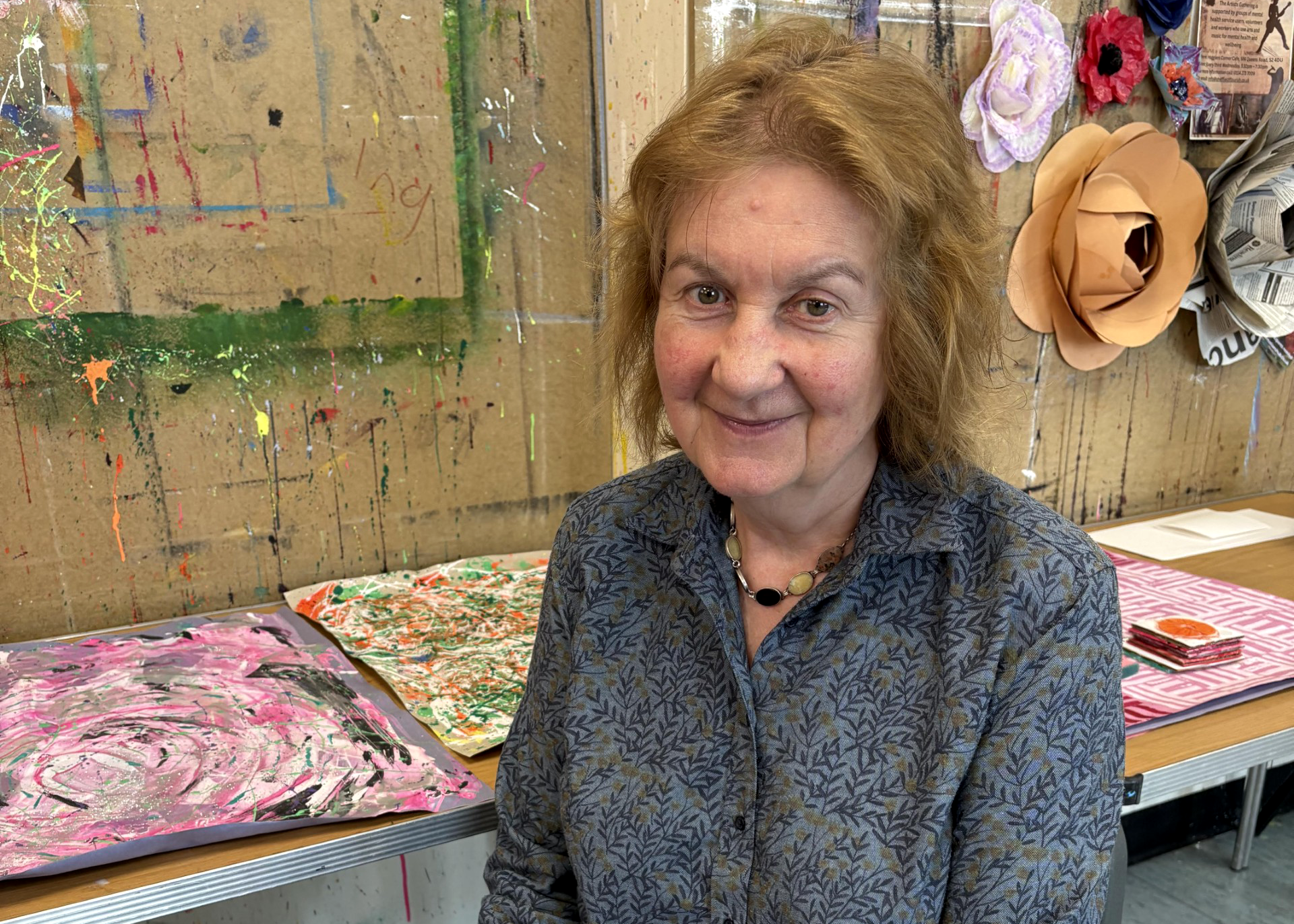
Presented at the Annual General Meeting (AGM) in mid-June, the award, in its third year running, celebrates Chris’s outstanding career as an art therapist, educator, researcher and advocate, as well as her ongoing commitment to improving the lives of people living with psychosis.
Throughout her career, Chris has combined clinical practice with research, education and public engagement. She continues to work as an art therapist within NHS mental health services, delivering individual and group art therapy, while also serving as an Honorary Research Fellow at the University of Sheffield. Her work has consistently championed the voices and lived experiences of service users, particularly through her research into psychosis, the Hearing Voices Movement, and the impact of poverty and inequality on mental health.
Alongside her clinical work, Chris has made a significant contribution to the education of future art therapists through postgraduate teaching, leadership and supervision. As former Course Leader for the Art Therapy Northern Programme, she has inspired generations of practitioners to think critically, practise in an ethical way, and engage with the challenges facing the profession.
Chris’s research, publications and collaborative work have strengthened the evidence base for art therapy and helped build meaningful partnerships between academia, practitioners and communities. Beyond her professional roles, she is Chair of the Board of Trustees for Art Refuge, supporting collaborative work with people affected by migration and displacement.
This Lifetime Achievement Award recognises not only Chris’s remarkable achievements, but also her leadership, generosity and unwavering commitment to the art therapy profession and the people it serves.
On receiving the award, Chris said:
“Finding pictures for the slides to show during the award has been enlivening. That process made me remember how important it is to keep going with things that give us meaning.
I intend to keep thinking and writing about working alongside people with a diagnosis of psychosis. Clients I work with, art therapists in my NHS team, and many colleagues from a range of places including Sue Holttum, Kay McFarlane and Laura Richardson help me consider what works when people with a diagnosis are troubled. The work of clients and colleagues in the Hearing Voices network has been inspirational (Wood, 2020a; 2020b).
I also value highly the work of the Equality Trust and how it researches the impact of poverty on all aspects of physical and mental health. Patricia Watts has helped with my thinking about how we filter this knowledge and use it in art therapy. Bobby Lloyd, Miriam Usiskin and many of the excellent colleagues working with Art Refuge also help me understand many aspects of the work and how good it is seeing people rekindle their imagination despite the difficulties of their lives. I have learnt a great deal from clients and colleagues who have worked alongside me over the years. Our understanding of the world seems to come out of the shared support of people who stand beside us.
I was fortunate, it is hard for this generation to imagine that I did not need to pay for my education; I worry now for younger people about the cost of education and training. It is hard and I hope it changes. Yet, new research in art therapy about staff burnout (Tjasink, et al. 2025) is hopeful. Tjansink’s open-access paper about a systematic research study is worth reading.
It is helpful in several ways for a range of health care professionals, not least art therapists. The study described helps confirm that we all need time and space to feel and think. It suggests that a relatively small investment in staff can make a positive difference in large health care organisations where many grapple with life-and-death issues. Life and death issues are woven throughout many aspects of our work, especially, but not exclusively, in the face of more wars internationally and their widespread impact on the mental health of millions who experience wars directly and those of us who watch on our screens.
I hope more people will get involved with the BAAT council, the BAAT groups, and the Unions as we face another period of austerity. Nevertheless, there are things we can do to help create art therapy employment.
Somehow, we need find the humour, resilience and playfulness to keep defending the profession, our work, and our clients. I think we can do that.”
Click here to view the slides from Chris’s presentation at the AGM
Somehow, we need find the humour, resilience and playfulness to keep defending the profession, our work, and our clients. I think we can do that.
References:
Holttum, S.; Wright, T.; Wood, C. (2021) Art therapy with people diagnosed with psychosis: therapists’ experiences of their work and the journey to their current practice, International Journal of Art Therapy, DOI: 10.1080/17454832.2021.1893370
Tjasink M, Carr CE, Bassett P, Soosaipillai G, Ougrin D, Priebe S. (2025) Art therapy to reduce burnout and mental distress in healthcare professionals in acute hospitals: a randomised controlled trial. BMJ Public Health. 2025;3:e002251. https://doi.org/10.1136/bmjph-2024-002251
Watts, P. and Wood, C. (2026 forthcoming) ‘How can art therapists make their practice more responsive to the realities of poverty?’ in M.R. Brady (ed) A Handbook of Art Therapy for Children and Young People. Jessica Kingsley.
Wood, C. (2020b) Acceptance in the Hearing Voices Movement: how might this be relevant for art therapy service-users? International Journal of Art Therapy: https://www.tandfonline.com/doi/abs/10.1080/17454832.2020.1795697
Wood, C. (2020a) Hearing Voices Movement and Art Therapy, Art Therapy Journal of the American Art Therapy Association: https://www.researchgate.net/publication/342255749_Hearing_Voices_Movement_and_Art_Therapy