An interview with our ambassador, Jason Wilsher-Mills
Article
InSight – Spring 2026
In November 2025, we announced acclaimed artist Jason Wilsher-Mills as our first ambassador. We caught up with Jason to talk about his work, what motivates him and why he said yes to becoming our ambassador.
 For people meeting you and your work for the first time, who are you and how would you describe your art practice?
That’s a good question. I was born into a very working-class family – a very big family. I’m the youngest of eight siblings, born at the tail end of the 1960. I had a very brilliant childhood, did all the usual stuff that kids do on council estates and got up to no good and all that kind of thing.
But at age 11, I got chickenpox which didn’t go the way the virus usually goes. It attacked my central nervous system and I became disabled. I was initially paralysed from the neck down and in hospital for a year. So, my life changed dramatically. But I was encouraged to pursue education and that opened up the world to me.
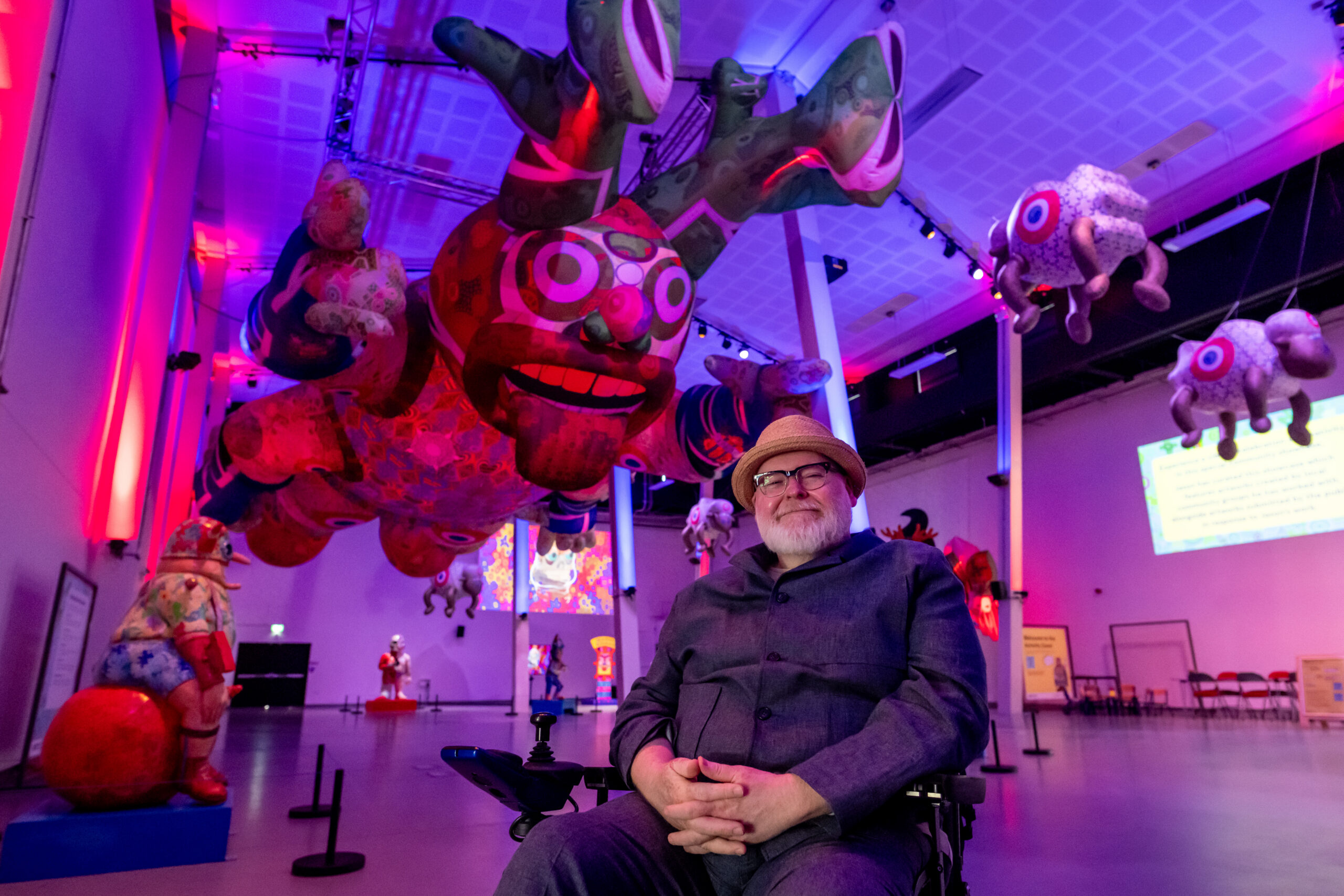
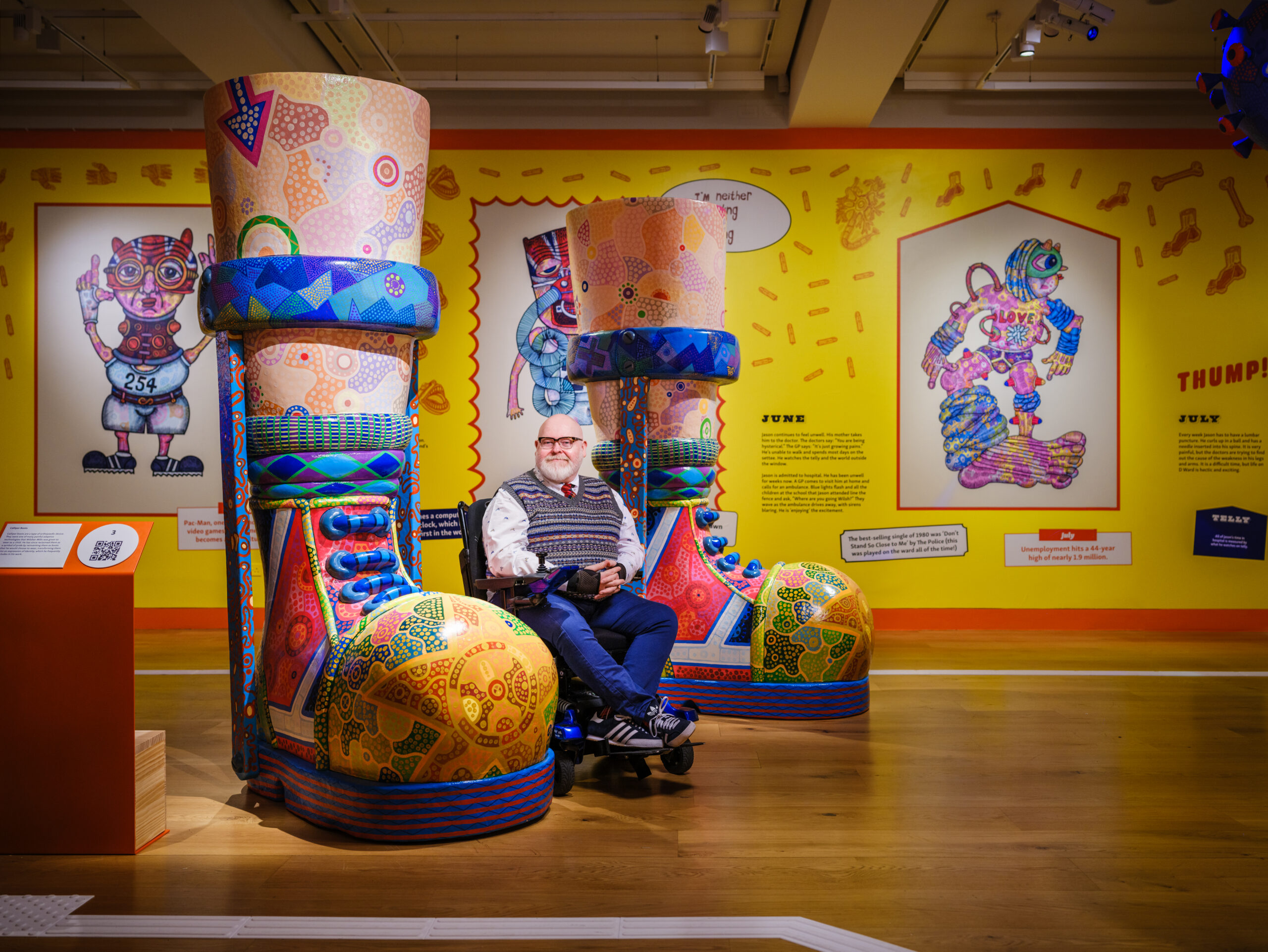
I went to art college and here I am today: 56 and a practising artist who creates art that is about those experiences, using humour and popular culture. I always imagine myself like I’m working for the Beano in 1973, and because my work has a kind of ‘PG rating’ I can get away with work that’s quite subversive.
What first made you want to make art?
Well, it’s a funny one. I reckon that you have something at birth that kind of is pointing you towards that because, as I said, I come from a big family and I don’t know if genetics skipped a generation or something happened, but I was just kind of interested in colour.
I remember at six years old, we didn’t have much money, but we used to go on holiday every year and to this place on the east coast of Yorkshire called Withernsea. I always say when I’m giving speeches now that working class kids didn’t go to galleries, we went to the seaside and that’s where we saw art. And I saw a painted fairground ride of Doctor Who. I didn’t understand how someone could have painted that – but someone must have. Then if they could paint that and make it look like that person, then that must be like, a job. It was such a huge moment. I can remember that feeling as a little kid, just looking at it and thinking, ‘Blimey, this is incredible’ and that’s what I always wanted to do, really.
I always think there must be lots and lots of working-class kids from whatever background not knowing who they really are, you know, because no one has shown them what’s possible. They haven’t seen an example of the possibility of what or who they could be.
What do you hope people take away from encountering your work?
Well, I hope adults get a sense of, ‘Blimey, I recognise some of this’ because my work is really about childhood and childhood trauma. I’m making it from that viewpoint. Sometimes I think it would be easier if I made things out of concrete and bitumen and was being very kind of earnest and stuff, but the trauma goes in and comes out the way it does! So for adults, I want them to kind of be familiar and kind of really be challenged by the work, but I want to make them laugh as well.
Bizarrely, my work is really popular with kids and families. The exhibitions have just been huge with families. I think the exhibition at Ferrans Art Gallery in Hull had an 62,000 people visit, and most of those were families.
I think it’s the story that I’m telling, because it’s all about stories. It’s a kind of constant myth making and people are interested in them. And I like the fact that they bring their own experiences to the work as well.
You were recently awarded an MBA for your work as an artist and disability advocate. What has that recognition meant to you?
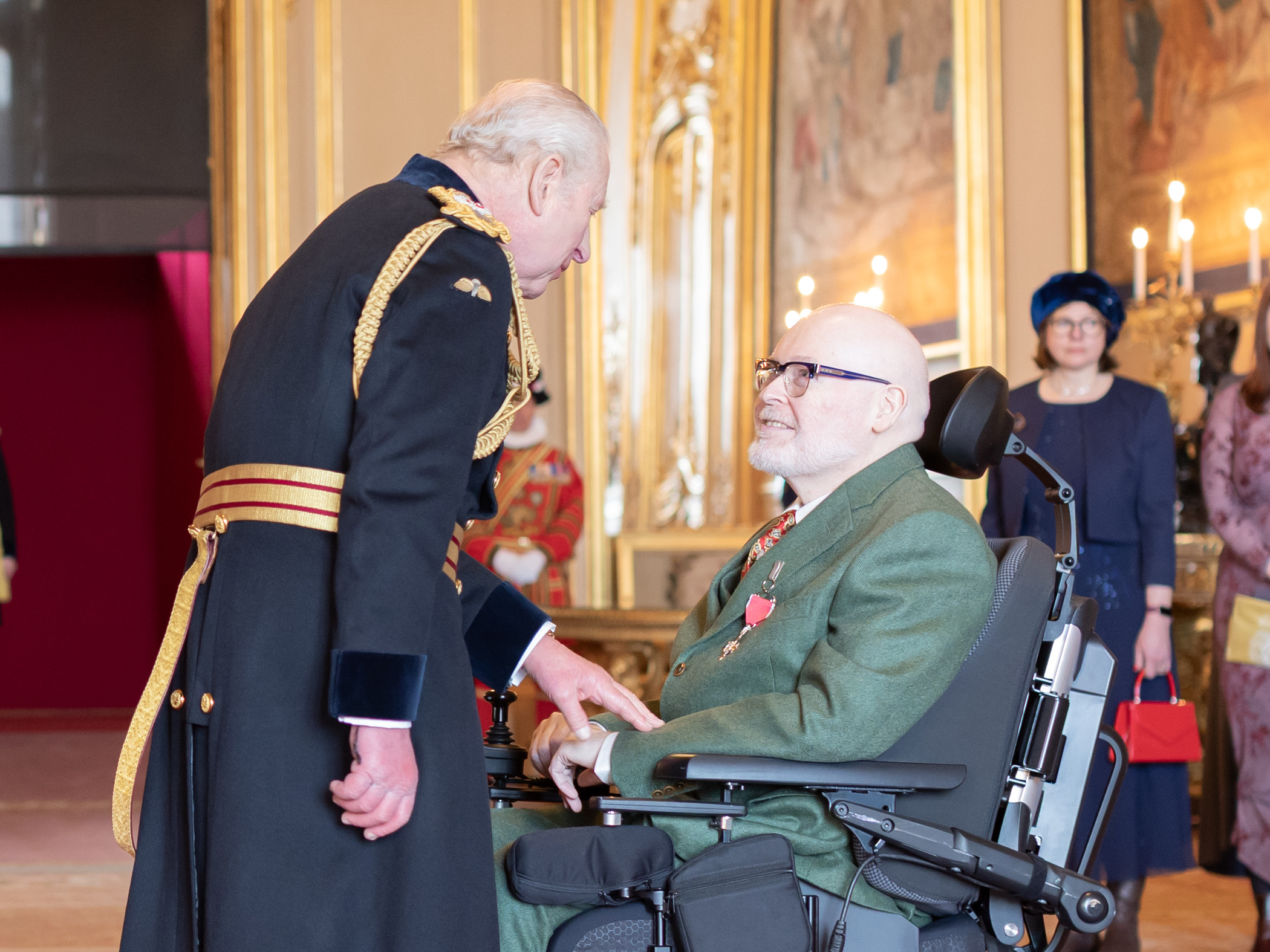
Well, my left-wing mates are calling me a champagne socialist now but I’m a real Beatles obsessive. I absolutely love them. And I thought, ‘‘Well, if it was good enough for The Beatles, it’s good enough for me’. John Lennon did actually give his back, so you can always make a statement with it.
My mum and dad passed away some years ago and I think they would be absolutely revolving in their graves if I didn’t accept it, bless them, so I’m accepting it as a little nod to me mum and dad.
I think it will also give me an opportunity to open a few doors that maybe I wouldn’t have been able to – and at the end of the day, it’s a nice day out, isn’t it? I might get some nice quarter-cut sandwiches and enjoy it.
And it’s nice getting the recognition. I joined the Boys Brigade when I was 10 because I wanted the badges and the awards and stuff. I think I’ll probably wear it all the time and just wave it around.
What barriers around disability – or other barriers – would you like to see broken down?
I’ll tell you what I would love: trains to be better in this country because that would make my life so much easier. I’m OK if I’m going down to London or up to Scotland, but if I want to go across country on a train it is a nightmare. Fortunately, I have a PA who travels with me and makes sure I’m not left on the train (which has happened) or put on the wrong train (which has also happened!).
Most of the barriers that people face are really practical that could probably be solved. I’m waiting for my shoulder to be reconstructed, so I can’t drive all that fast, so I am completely reliant on public transport and accessible taxis (which is another issue). But if you boil it all down, it’s about accessibility, about opportunity.
I’m perceived as a ‘disabled artist’, or an ‘artist with a disability’, and you know, fair play, I am. But I’m also an artist. I’m in mainstream galleries now. I want to compete with the others and have real equality there.
I always do this analogy with people when they say things like, “You’re doing well – nudge, nudge, wink, wink’. And I say: “I am, but I have to earn like £20-£30,000 more than my able-bodied counterpart because I have to invest so much in the costs of accessibility and stuff that I have to be over successful in order to just maintain.” It’s a bit bonkers, but it’s what drives me because I won’t give in, I won’t succumb to it.
One really positive recent development is Nnena Kalu, an artist with a learning disability, winning the Turner Prize. The glass ceiling has been broken. But in the back of my mind I think, “Well, they’ve done it now. Are they going to do it again? Are there going to be opportunities for other people?”
I’m perceived as a ‘disabled artist’, or an ‘artist with a disability’, and you know, fair play, I am. But I’m also an artist. I’m in mainstream galleries now. I want to compete with the others and have real equality there.
What made you say yes to becoming our first ambassador?
When I was 16, I’d recovered to the point of being able to go to an FE College before going to university. My careers officer nominated me for ‘young person of the year’ – a BBC Radio One thing, I’m into my awards as you can see. He nominated me because I was really interested in becoming an art therapist. My thinking at the time was ‘I’ve survived this illness, I wasn’t supposed to live beyond 16, so maybe I could do this now’. I went to Richard Branson’s nightclub in Kensington for the award ceremony, which was completely surreal – there were flamingos there, they gave me caviar and I didn’t know what to do with it because I’ve never seen it before.
But it goes back to that point in my life, because looking back, what I meant by being an art therapist is I wanted to help others. And what I was actually doing with my art was self-medicating, and I think I’ve done that all throughout my practise.
All through my life I’ve been dealing with that and using art as my own therapy.
I talk very openly about how what happened to me as a kid was childhood trauma. I was in hospital for a year, and all I will say about it is, thank goodness the NHS exists because they saved my life. But being in the hospital as a child wasn’t a safe place for me, which again is a trauma. All through my life I’ve been dealing with that and using art as my own therapy. I’ve also worked really hard in making sure there’s representation and support for disabled people and disabled communities. I’ve focused on working with those groups, and I’ve probably been passing on some of my self-medicating techniques.
I don’t say yes to everybody. I really think about whether I want to wear that T-shirt. But I just thought it was a lovely fit, and really interesting. I spoke at BAAT’s conference in 2024 and met these really interesting people. I was listening to some of the processes they were talking about, and I thought ‘Blimey! I do that on my own work!’. I was really impressed by the people that I spoke to at that conference. That’s what swayed me.
I’m an eccentric choice because, you know, I tell jokes when I give speeches and I talk about Sooty and Sweep and stuff. And my wife’s a counsellor as well, and she was very perturbed that I got in a therapy magazine!
What keeps you motivated in your work?
It’s about doing the best work I can, because I’m incredibly self-critical. I want the work to be substantial. And I love doing new stuff. This year I’ve done my first tapestry, and it was created in Belgium by the guys that do old Grayson Perry’s, so it’s been a really wonderful process.
I created artworks for the Blackpool Illuminations as well, which fits the manifesto of ‘we’re bringing art to the people’. I hope there’ll be a little geezer or a little sheezer that goes, and maybe a Black working-class kid who sees my art and hopefully thinks oh, ‘I could do that’. So, what keeps me going is that I hope that my art keeps talking to people and I’m inspiring other people.
And doing good stuff and making a difference, and also being kind because I think, frankly, we need kindness more than ever. And what I mean by that is making a piece of art that can change things a little bit. Like my changing places sculpture; wherever it’s been, there’s now an accessible changing places toilet. Families with disabled children can now go to a museum that they couldn’t go to before or an art gallery or a cinema or whatever – and it’s because of a daft piece of art that told the story and worked as a Trojan horse. People looked at it and thought, ‘Oh, it’s colourful and nice and stuff’, and then my little activist soldiers escaped and did their thing. So long may that continue.